
Reviewed · ADDIS ABABA CITY TOURS
Gondar city Tour With Airport & Hotel Pick Up
Gondar’s story comes alive inside Fasil Ghebbi, where palaces, churches, and royal buildings fill a walled fortress-city built for Ethiopian emperors. This tour also takes you to Fasilides Bath, the ceiling paintings at Debre Birhan Selassie Church, and Wolleka, the former home of Gondar’s Ethiopian Jewish community. I like the way the route joins major monuments with places that explain the city’s wider culture. I also like the practical pickup service, especially if you are arriving by air and want to start sightseeing without sorting out local transport.
The main consideration is pace. Four stops fill roughly seven and a half hours, and Fasil Ghebbi and Debre Birhan Selassie each receive about two hours. Wolleka includes craft stalls and persistent sales pitches, so you should be ready for a less quiet ending to the day.
Key points at a glance
- Fasil Ghebbi takes center stage: Explore the former imperial compound, with castles, churches, walls, and buildings shaped by Ethiopian, Hindu, Arab, and European influences.
- Fasilides Bath has a living role: The bath is filled each January for Timkat, the Ethiopian Orthodox celebration of Epiphany.
- Debre Birhan Selassie rewards careful looking: Its painted interior and symbolic towers make it one of Gondar’s most important churches.
- Wolleka adds a difficult chapter: The former Falasha village introduces Ethiopian Jewish history, craft traditions, and the effects of migration.
- The day is easy to arrange: Pickup is offered, the vehicle is air-conditioned, and admission fees listed in the program are included.
- Small-group format keeps it manageable: The maximum group size is 10, with a Blue Badge guide included.
Why Gondar makes a strong first stop
Gondar was founded by Emperor Fasilides in the 1630s and served as the royal capital of Ethiopia for about 250 years. That period brought renewed attention to architecture, literature, education, music, painting, and commerce after the decline of ancient Aksum.
You can feel that change in the city’s monuments. Gondar is not built around one isolated sight. Its appeal comes from the way royal power, Orthodox Christianity, trade, and craftsmanship meet within a compact sightseeing route.
This tour gives you a broad introduction in one day. You see the imperial compound, a ceremonial bath, a major church, and a former Jewish settlement. I find that mix more useful than a day spent only looking at castles, since it gives you a clearer sense of how different communities shaped Gondar.
The tour begins at 9:00 a.m. at Central Hotel, with pickup offered for airport or hotel arrangements. The supplied information also notes that an airport representative met one customer on arrival, and tour manager Mickey helped arrange local guides. If your arrival and sightseeing plans are close together, confirm the exact pickup point and timing before the day begins.
More addis ababa city tours in Ethiopia:
- Addis Ababa Guided City Tour With Airport & Hotel Pick Up
★ 5.0 · 237 reviews - Full-Day Private City Tour of Addis Ababa
★ 5.0 · 147 reviews - Addis Ababa Authentic Private City Tour
★ 5.0 · 134 reviews
Inside the walls of Fasil Ghebbi
Allow about two and a half hours for Fasil Ghebbi, the largest stop on the route. This former fortress-city covers about 70,000 square metres and is enclosed by roughly 900 metres of wall.
Inside, you find palaces, churches, monasteries, and public and private buildings. The architecture reflects several outside influences. Hindu and Arab design elements appear alongside Baroque features associated with Jesuit missionaries who came to Gondar.
The result is unlike a single-style European castle complex. You are looking at an Ethiopian royal center that developed through local building traditions and contact with foreign visitors, religious figures, and craftsmen.
Dawit’s Hall is among the buildings within the compound. The site also includes royal structures linked with Emperor Fasilides and later rulers. Your guide matters here because many walls and rooms can look alike at first glance. A good explanation helps you connect a building’s shape with its former use and place in court life.
To the south is Adababay, once Gondar’s marketplace and the place where imperial proclamations were made, troops were presented, and executions took place. It is now a city park. That change is worth noting. The space still belongs to the city’s public life, but its role has shifted sharply from imperial ceremony to ordinary urban use.
I would not rush this stop. Look beyond the most recognizable palace. Notice the scale of the enclosure, the mixture of building forms, and the way the walls frame Gondar’s royal past. The drawback is that two and a half hours can feel long if you prefer a quick photo stop, but anyone interested in Ethiopian architecture will need the time.
Fasilides Bath and the Timkat connection
The next stop lasts about an hour and has a different mood. Fasilides Bath is a walled compound with a bath, central tower, and bridge used when the bath is full.
The structure is usually linked to Emperor Fasilides or his son Iyasu I, though its original commissioner is not known. Ancient badian trees have sent roots through the old brickwork, giving the compound a weathered appearance. That detail makes the site visually memorable, but it also reminds you that these buildings need care.
Fasilides Bath is not simply an abandoned royal swimming pool. Once a year, on January 19, the bath is filled for Timkat, the Ethiopian Orthodox celebration of Epiphany. The ceremony recalls the baptism of Christ in the River Jordan.
If your visit does not coincide with Timkat, you will see the space in its usual dry state. Even so, the bath’s religious role gives the monument more meaning than its name might suggest. Ask your guide to explain how the compound functions during the festival, and pay attention to the bridge and tower rather than looking only at the pool.
This stop is shorter and easier to absorb than Fasil Ghebbi. It also breaks up the palace-and-church pattern with a site tied to a major annual event. Since admission is listed as included for the program, you do not need to budget a separate entrance charge here.
Painted ceilings at Debre Birhan Selassie
Debre Birhan Selassie Church receives about two hours, and that is sensible. The church is one of Gondar’s most important places of worship and is known for its paintings.
Its name means Trinity and Mountain of Light. Twelve rounded stone towers surround the church, representing the twelve apostles. A taller thirteenth tower represents the Lion of Judah, and a Lion of Judah imprint can be seen near the top.
The present church followed damage to an earlier structure. The original building was reduced to rubble after a raid by Sudanese Dervishes and a lightning strike. The church was redeveloped in the 1880s, while its paintings preserve the visual language that makes the site so important.
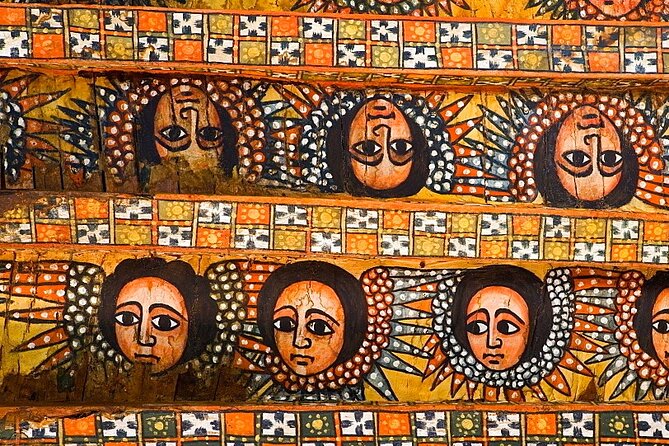
Inside, lift your eyes. The painted ceiling is the feature most people remember, with rows of angel faces looking down from above. The paintings are not decoration added for atmosphere alone. In an Ethiopian Orthodox church, images help communicate religious stories and ideas to a congregation that may not read written texts.
Your guide can help you read the symbols and distinguish the church’s religious purpose from its architectural details. Dress and behavior should be respectful because this remains a place of worship, not just a historic building.
Two hours gives you time to examine the ceiling, understand the church’s history, and appreciate the towers outside. It may be more time than you need if you are not interested in religious art, but it is a worthwhile pause after the open spaces of the royal compound.
A few more Ethiopia trips to weigh up
- Authentic Addis Ababa City Tour with a Local Guide
★ 4.9 · 109 reviews - Addis Ababa highlight city tour
★ 4.8 · 107 reviews - Addis Ababa Guided City Tours
★ 5.0 · 57 reviews - Every day Addis Ababa City Tour
★ 5.0 · 54 reviews
Wolleka and the story of Gondar’s Ethiopian Jews
Wolleka, also called Falasha Village, gives the day its most complicated stop. The former settlement was once home to a large Ethiopian Jewish community. Most residents were airlifted to Israel in the 1980s, and none remain today according to the supplied tour information.
You can still see a few original houses with artwork on their fronts and a small synagogue. Local craft stalls use Stars of David and Falasha Village signs to mark the area’s connection with that past. A small payment of 10 birr is noted for entering the synagogue.
The history is difficult. After Christianity became Ethiopia’s state religion, Falashas had land taken from them because they refused to convert. Many survived by developing skilled craft trades, and research suggests that Falasha labor may have contributed to the construction and decoration of Gondar’s churches.
This stop is valuable because it moves beyond royal monuments. It shows that Gondar’s identity was shaped by more than emperors and Orthodox churches. At the same time, you should approach the village with care. It is not a preserved community in the usual sense, and the craft stalls can make the visit feel commercial.
Persistent sales pitches from children are a known part of the experience described for this stop. You may find it useful to decide in advance what you want to buy, if anything, and to keep your visit focused on the surviving houses, synagogue, and historical setting.
Two hours is a substantial allocation here. If you want only the major castle and church sights, Wolleka may feel less essential. If you want a fuller picture of Gondar’s communities and difficult past, it adds real value.
What the $90 price covers
The listed price is $90 per person. That is not a bargain-basement walking tour, but it covers a full day of organized sightseeing rather than one monument.
Included are an air-conditioned vehicle, airport or departure tax, a Blue Badge guide, entrance fees according to the program, and government taxes. Pickup is offered, and the vehicle matters in Gondar because the route includes several separate sites rather than one compact enclosure.
The value depends on how much you would otherwise spend arranging transport, entrance tickets, and guides at each location. The strongest part of the package is its range. In one day, you cover four major places and receive interpretation across royal, religious, and community history.
The group maximum is 10. That is small enough to be more personal than a large coach outing, although the actual group size can vary. A previous booking was described as well organized, with Mickey arranging guides and an airport meeting, plus lunch during the day. Lunch is not listed among the inclusions, so treat it as an example of how the day was handled rather than a guaranteed feature.
Because the tour averages booking about 18 days ahead, I would not leave it until the last moment if your Gondar schedule is fixed. Confirmation is provided at booking, and free cancellation applies if you cancel at least 24 hours before the local start time. Changes or cancellations inside that window are not refunded, and the tour requires a minimum number of participants.
How the day may feel in practice
The order begins with the biggest historical site and then moves through two more monuments before ending at Wolleka. That makes sense for orientation, since Fasil Ghebbi gives you the clearest picture of Gondar as an imperial capital.
The total duration is approximately seven hours and 30 minutes. You should expect a full sightseeing day, not a short city sampler. The itinerary gives two and a half hours to Fasil Ghebbi, one hour to Fasilides Bath, and two hours each to Debre Birhan Selassie and Wolleka.
An air-conditioned vehicle is included, which is useful during a long day with several stops. The tour ends back at the meeting point, Central Hotel, unless your pickup arrangements are handled differently with the operator.
The guide is an important part of the experience. Fasil Ghebbi’s buildings and Wolleka’s history both benefit from context, while Debre Birhan Selassie’s paintings and symbols are easier to appreciate with explanation. The supplied feedback specifically praised the organization by Simien Mountain Trekking and Tours, Mickey’s coordination, and the guides who covered the main sights.
The listing identifies the guide as Blue Badge certified, but it does not provide the names of the individual guides who lead every departure. Mickey is named as a tour manager involved in arranging guides, so ask who your guide will be when confirming pickup.
Who should book this Gondar tour?
I would choose this experience if you have one full day in Gondar and want the main sights handled in one plan. It suits first-time visitors, people arriving by air, and anyone who wants historical explanation rather than simply a driver between monuments.
It is also a good fit if you want more than castles. Fasil Ghebbi supplies the grand royal setting, Debre Birhan Selassie supplies the art, Fasilides Bath connects the city to Timkat, and Wolleka introduces an important minority history.
I would think twice if you dislike a structured day or prefer to spend a long time at one site. Wolleka can also feel uncomfortable if sales pressure bothers you. The tour is strongest when you treat the route as a broad introduction to Gondar, not as four leisurely independent visits.
Should you book it?
Book it if the $90 price fits your budget and you value included transport, admissions, and a guide across four very different Gondar sights. The airport pickup is particularly useful on arrival day, and the maximum group size of 10 keeps the format reasonably contained.
Skip it if you only want Fasil Ghebbi and Debre Birhan Selassie, or if you prefer setting your own pace. For most first visits, though, the combination of imperial buildings, church art, Timkat tradition, and Wolleka’s difficult history makes this a practical and worthwhile introduction to Gondar.
FAQ
Where does the Gondar city tour start?
The listed meeting point is Central Hotel in Gondar, at JF69+7RM. The activity starts at 9:00 a.m.
Does the tour offer airport pickup?
Yes. Pickup is offered, and airport or departure tax is included. An airport meeting was also arranged for a previous booking.
Does the tour offer hotel pickup?
Yes. The tour information states that hotel pickup is offered. Confirm the exact pickup details with the operator before the tour.
How long does the tour last?
The tour lasts approximately seven hours and 30 minutes.
What sights are included?
The route includes Fasil Ghebbi, Fasilides Bath, Debre Birhan Selassie Church, and Wolleka, also known as Falasha Village.
Are entrance fees included?
Yes. Entrance fees according to the program are included, along with government taxes.
How many people can join the tour?
The maximum group size is 10 people.
What is the cancellation policy?
You can cancel at least 24 hours before the local start time for a full refund. Cancellations or changes made less than 24 hours before the start time are not refunded or accepted.
Just added around Ethiopia
- Yod Abyssinia Cultural Night: Dinner, Music, and Dance★ 5.0 · 7 reviews
- 2 days Tigray Church★ 5.0 · 3 reviews
- 3 days tour Danakil Depression (Dallol & Erta Ale)★ 4.0 · 5 reviews
- Trekking in Ethiopia’s Lalibela Wollo Highland 4 Days / 3 Nights★ 5.0 · 6 reviews
- 2 Days Dallol Trip★ 5.0 · 4 reviews
- The Rock-Hewn Churches of Lalibela: 3 Days / 2 Nights★ 5.0 · 6 reviews
- Lalibela Backpacker tours★ 5.0 · 6 reviews
- Lalibela churches Guided Tour★ 5.0 · 6 reviews
Addis Ababa City Tours, compared.
Addis Ababa Guided City Tour With Airport & Hotel Pick Up
Read our review →
Addis Ababa City Tours Full Day With Hotel Pickup And Drop Off.
Read our review →
Addis Ababa +Mount Entoto View Point,Museums Palace Market Tours
Read our review →
Browse the lists this tour appears in